 My inner geo-nerd is in ecstasy. (From Reddit)
Saturday, March 26, 2011
Potholes Most Beautiful and Most Wonderful...
There is a grandeur in this view of road repairs... My inner geo-nerd is in ecstasy. (From Reddit)

Friday, March 25, 2011
Farting Around On Friday
I've been exhausted by the news lately. So I've been enjoying messing around with the latest meme to sweep through Twitter: #GOPMovies. Click that link for more examples than you'll want, but here are the ones that have occurred to me this afternoon:
#GOPMovies Terminator V: Feed the Machines
#GOPMovies The Incredible Shrinking Empathy
Any other ideas?
#GOPMovies Terminator V: Feed the Machines
#GOPMovies Band of Birthers
#GOPMovies Animal House... and Senate
#GOPMovies Atlas Smirked
#GOPMovies Full Metal Straitjacket
#GOPMovies Taxes Chain Saw Massacre
#GOPMovies Four Weddings, Three Divorces, and A Funeral
#GOPMovies Predator Vs. The Economy
#GOPMovies Dr. Wolfowitz, or How I Learned to Stop Worrying and Love War
#GOPMovies Being John Boehner
#GOPMovies The Blair Witch Burning
#GOPMovies Flashdunce
#GOPMovies Extraordinary People
#GOPMovies The GOPS of Wrath
#GOPMovies Nutwork
#GOPMovies Godzilla Vs. The Real Americans
Any other ideas?
Thursday, March 24, 2011
Answers To a Couple of Long-Standing Questions
A couple of questions that have nagged me for a while- but for which I haven't bothered to track down answers- are "What is the rate at which we are using oil compared to the rate at which it forms," and "When was the last formally (i.e. Congressionally) declared US war?" On the surface they're unrelated, but looking at our current conflicts, I think you can make a case for an important relationship. Even Afghanistan, which has little in the way of fossil energy resources, can be interpreted at least in part as a manifestation of Muslim anger at perceived exploitation by western corporate interests.
Yesterday, I came across a quote in an interview in Der Speigel claiming "...we consume as much oil in one year as was created in 5.3 million years." I have guesstimated that our rate of consumption is about a million times greater than the rate of generation, but that was just an off-the-cuff stab at the magnitude. While I'd sure like a citation or link to how the method by which "5.3 million" was calculated, it sits comfortably in the range I'd expect, and I'm pleased (though uneasy) to finally see an estimate.
I just Googled the second question, and found this in a PDF (817 kb) from the Congressional Research Service: "The last formal declaration of war was enacted on June 5, 1942, against Rumania during World War II." I had thought maybe Grenada or Panama (during the Reagan administration) had been formally declared wars, but I wasn't sure. Nor was I sure about Desert Storm under Bush Senior. I guess I'm kind of surprised that there has never been an "official" US war during my lifetime.
Tuesday, March 22, 2011
Cobbles and Gravel
Tohoku (previously referred to as Sendai) Earthquake
- Via everybody everywhere, XKCD has posted a chart illustrating the magnitude of concern you should have regarding radiation releases from the Japanese reactors. (Spoiler: not so much) ZOMG! Bananas! Domestic Partners! What's my exposure from a cat sleeping in my lap!? Additional fun and enlightening commentary at The Vigorous North.
- Michael Welland at Through the Sandglass has a piece on tsunamis in the historic and sedimentary records, and implications for human development of vulnerable areas.
- Power line connections have been completed to the crippled reactors in Japan; water pumps will be tested soon. Hopefully, this is nearly the end of the on-going nuclear crisis there.
- There have been several good posts on the nature of surface deformation in the neighborhood of the quake. I get exasperated with the breathless statements like "Japan moves eight meters east" and "Earth's day shortens" as a result of the quake. Portions of Japan did move east- some more than others, but not the island nation as a whole- and the earth's rotation did speed up- just as an ice skater who tightens their arms against their body will increase their rate of spin. But what is never mentioned in these kinds of headlines is that over the next centuries, as the area around the fault is stressed and strained, and another earthquake builds, is that the same areas will move west, and as the land surface rises again, the earth's spin rate will slow. It's cyclic. Yes, these happened quickly, but the fact that the motions happen in reverse slowly doesn't mean the counterpart of the sudden motion is unimportant. Hudson Valley Geologist has a good color-coded map of how much different areas moved; Highly Allochthonous puts together an excellent round up of information and links; The Chatterbox: it's not just the tsunamis; subsidence means some areas will stay flooded; a variety of teaching resources from Hudson Valley Geologist. In particular, note the video clip; Jorge at Structural Geology provides a nice explanation, an excellent set of schematics, and lots of links; finally, Callan at Mountain Beltway shows the horizontal and vertical components of overall ground movement from before to after the quake. Keep in mind though, as I said in the introduction to this bullet, this nearly instantaneous movement will be reversed in large part, and "reset" over much longer timescales in the decades and centuries to come. Then it will happen again.
- Because People Could Die: A culture of nonchalance and our resentment of those who challenge our laziness can kill us, from Swanson Tea.
- Anne Jefferson at Highly Allochthonous has a great summary piece on the tsunami(s).
- If I had to pick one image to express how blown away I've been by the last twelve days of news out of Japan, it would be this one, first seen at Steve Gough's Riparian Rap: cars on the roofs of three-story buildings.
- Tillamook, OR oyster farmer to donate larvae to assist Japanese oyster industry's recovery. (with video)
- Brookings, OR Harbor reopens; Damage estimate reduced from $10 million to $6.7 million; Federal disaster assistance requested. OregonLive.
- If you insist on worrying about radiation from Japan in the PNW (please don't), OregonLive has an article about resources you can use. Most important, there's a link to radiation monitors' recent daily data in Oregon. (link for Washington at the OL article) First sentence at the site: "Radiation from the damaged nuclear reactors in Japan is not a health risk in Oregon."
- Portland Hospitals claim to be prepared for "The Big One." This is some of the best preparedness news I've read in a long time, and I think it sounds well-founded, not just PR.
- On the other hand, older Portland homes (pre-80's) not so much. The good news, though, is that retrofitting the typical private home is not likely to be as expensive as I might have guessed.
- And on yet still another hand, Portland schools have been retrofitted with an eye to allow survivability, but not continued usability. In other words, occupants will most likely be able to escape safely, but buildings will not be salvageable afterwards. I have mixed feelings about this strategy, and I'm hoping it's a temporary first step, with schools able to withstand a major quake and be usable afterwards replacing older, weaker structures as funds become available. Schools and other public properties can be critically important shelters and organizational centers after disasters... as long as they're safe to use.
- I first read about this months ago, and I've been meaning to comment, but in the meantime, Cannon Beach, OR planning to build nation's first tsunami-resistant building. My quick response: I'm dubious, and I'm afraid that if the conditions are exactly wrong, this could be a terrible liability magnet.
- Oregon Expat posts a video I haven't yet taken time to watch, examining the OR coast and its tsunami risks. Another topic I've been hoping to get to, but haven't set aside time. Short version: much of the coast is situated on elevated terraces, and at-risk sites are limited in area. However, most coastal communities are situated near harbors with adjacent estuarine-tidal flat lands moderately to heavily developed. So a majority of communities have some of their most economically important land in vulnerable areas. Here's the OregonLive article Oregon Expat is working from.
- OregonLive: Don't turn your back on tsunami warnings. An excellent, startling video of the late tsunami at Depoe Bay (most famous as the location for the fishing excursion in the film One Flew Over the Cuckoo's Nest) The reason I say startling is that it really doesn't look like it's all that big a deal... until all of the sudden it obviously is a big deal. Also, if you missed it above, Chris embedded a time lapse video of the tsunami at Crescent City, CA so I didn't have to. For both these clips, you'll probably be happier with the sound way down or off, though I have to say with the Crescent City clip, the time lapse sound of the tsunami tsiren kind of made me giggle.
- Water in America, from State of the Planet.
- Dave Petley at The Landslide Blog has posted three excellent and riveting videos of risks associated with water. The "mudflow" (I'd call that a debris flow, but I'm no expert) clip in particular was new to me, and it looks very much like my neck of the woods.
- The Guardian typically does a good job with background information on these issue-du-jour types of observances, and World Water Day is no exception: A Global Inundation of Funds is Not Enough; Why Food Waste is Water Waste, Too.
- JFleck at Inkstain notes that the Colorado River Basin is in the clear as far as water shortages go. (Note: read the the comments if the irony escapes you.)
- Think gasoline is too expensive? Quiture whining. (Via Bits and Pieces)

- Incredible description and photo of pseudotacylite and megabreccia from Vredefort crater, South Africa at Erratics. Erratics is a blog created specifically for those who would like to dip their toes into geoblogging without the trouble and commitment of actually starting a new blog of ones own. Curious? Check it out!
- Via Iceland Volcano and Earthquake Blog and Eruptions, yesterday was the one-year anniversary of the beginning of the Eyjafjallajökull eruption. It started off beautiful, became a royal pain in the butt by disrupting European air travel, but it never killed anyone. My kind of disaster.
- This could fit in several different categories, but there has been some twitter discussion of a piece by Simon Winchester at Newsweek. Chris at Highly Allochthonous has posted the first blog commentary I've seen so far, but I expect this item will be under discussion for a while: watch for more. For the record, I'm not a big fan of Winchester. As an example, the first book of his I read was The Map That Changed the World. Let's just ignore his predilection for hyperbolic titles and statements, and my general distaste for phrases in the form of "The X that Y'd the Z," where X is a noun, Y is a catastrophic verb, and Z is a general noun carrying implications of "everything important." A person who didn't know who William Smith was would come away from that book with the idea that the great accomplishment of his life- emphasized and re-emphasized at least once or twice a chapter- was spending a few weeks in debtor's prison. Likewise with Krakatoa: The Day the World Exploded, I think the author makes a good case for the importance of that eruption. He admits very quickly and in passing near the beginning that it was not the largest eruption in recorded history- let alone geologic history. Yet an innocent and geologically naive reader might very well come away with the idea that it was the biggest explosion since the Earth was created; Winchester falls all over himself trying to find ways to supersize this eruption, just like a McDonalds clerk. And like McDonalds, there are way too many empty calories for my taste. As I commented at Chris' post, Winchester too often strikes me as more interested in marketing than informing.
- Ah Ha! Here's another bit of Winchester debunking at Life's Little Mysteries.
- "The battle to prevent dangerous climate change is over; the race to survive it has begun." Via Hot Topic. If only we could get the US House to legislate recalibrating the Fahrenheit, Celsius and Kelvin temperature scales, this wouldn't be a problem.
- I found this a baffling mixture of fact and fake, sense and nonsense; it's not totally wrong, but there's enough wrong that my BS detector was ringing at three-alarm levels. Calcite, for example, is much more plastic under high T&P than quartz; halite and gypsum even more so. However, the latter two aren't major components of rock on a global scale. Quartz could hold key to explaining earthquakes.
- Deaths per terawatt-hour from various electrical generation energy sources, via Swanson Tea.
- Sunday was the Vernal Equinox; Steven Schimmrich at Hudson Valley Geologist lays out the details.
- Garry Hayes at Geotripper takes his analytical skills to the next level, and predicts an earthquake today. And tomorrow. And the next day. And the day after that. Useful? You decide.
- If only idiots will vote for certain politicians and listen to certain shock-jocks, you can rest assured those pols and jocks will do everything they can to make sure everyone is an idiot.
Sunday, March 20, 2011
Sunday Funnies: I Should Go to Bed Earlier Edition

 Criggo

 Cyanide and Happiness
 EpicPonyz
 Non Sequitur
 Savage Chickens


 Bits and Pieces


 Alphaville
 Fake Science
 The High Definite
 Surviving the World

 Regretsy, with the helpful additional commentary from Helen Killer:
Oh it’s subtle, all right. In fact, you can barely feel it. Primarily because it doesn’t actually do anything. But don’t let that stop you! You just hold these copper rods from Home Depot in one hand, and stick this piece of zinc up your blowhole. It will act as a magnet, drawing money out of your Paypal account, and increasing your dipshit potential.


 Tree Lobsters
 Cyanide and Happiness


 Epic4Chan


 Non Sequitur
 Medium Large
Who knew a mom blowing her nose could be so terrifying... and so hilarious. Sofa Pizza
 Firedoglake
 Fake Science

 The Far Left Side
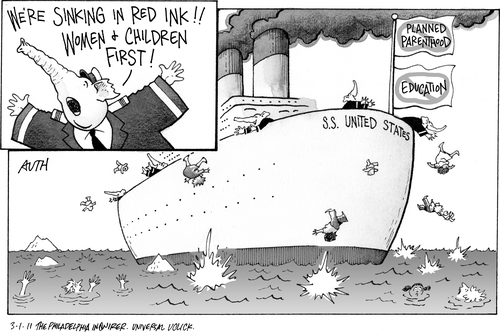 Sofa Pizza
 God Hates Protesters


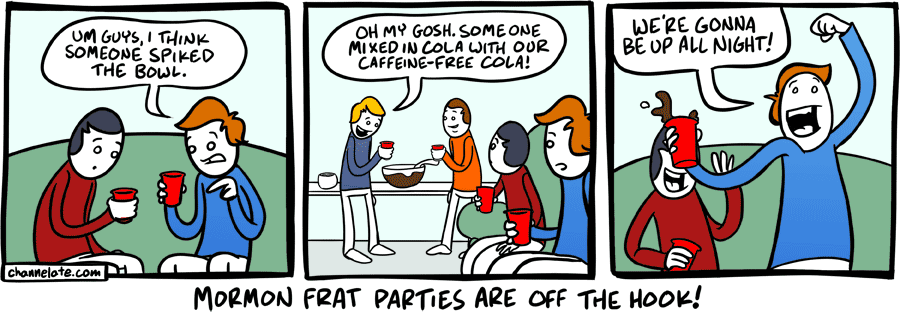 ChannelAte
 Medium Large

Thursday, March 17, 2011
When Danger Reared Its Ugly Head, He Bravely Turned His Tail and Fled

 So now we know.
Fingers Crossed
 I've been meaning to mention this for a while, but all sorts of news has been all sorts of crazy for the past week and more. On top of that, Interzone has (finally) switched ISP's, but the wifi is still buggy for long stretches at a time. To describe browsing as glacially slow would malign the celerity of glaciers. But in about two hours, the MESSENGER probe will fire its main engines for 15 minutes, allowing itself to be gravitationally captured, and become the first man-made object to orbit Mercury. The Planetary Society Blog has the time line and web resources (as well as the image above at a larger size) to follow it live, if that's your thing.
Even though Mercury is one of the closest planets, it's poorly known and studied. It's too close to the sun, from the earth's point of view, to get detailed telescopic images, and it's so deep in the sun's gravity well that spacecraft from earth have gained enormous speed after "falling" toward it from earth. That speed has to be nearly matched to Mercury's for the probe to orbit the planet. The MESSENGER probe has used a series of planetary flybys, over fifteen orbits of the sun, to bleed off some of its excess speed. Tonight's burn will be the conclusion of one voyage and the beginning of another, if all goes well.
Mercury is an important key to understanding the early evolution of the solar system, and I have little doubt there will be images and discoveries that flabbergast me. I'm pretty excited about this, and I'm keeping my fingers crossed.
Followup, 6:50 PM PDT: Reports coming from NASA say the orbital insertion maneuver has been successful; expect first imagery in a couple of weeks. Congratulations, NASA and MESSENGER!
Followup 2, 7:28 PM PDT: The MESSENGER news service I subscribe to just sent me this report, titled "MESSENGER Begins Historic Orbit around Mercury" Full text of report:
At 9:10 p.m. EDT, engineers in the MESSENGER Mission Operations Center at the Johns Hopkins University Applied Physics Laboratory (APL) in Laurel, Md., received the anticipated radiometric signals confirming nominal burn shutdown and successful insertion of the MESSENGER probe into orbit around the planet Mercury.
The spacecraft rotated back to the Earth by 9:45 p.m. EDT, and started transmitting data. Upon review of these data, the engineering and operations teams confirmed that the burn executed nominally with all subsystems reporting a clean burn and no logged errors.
MESSENGER’s main thruster fired for approximately 15 minutes at 8:45 p.m., slowing the spacecraft by 1,929 miles per hour (862 meters per second) and easing it into the planned eccentric orbit about Mercury. The rendezvous took place about 96 million miles (155 million kilometers) from Earth.
“Achieving Mercury orbit was by far the biggest milestone since MESSENGER was launched more than six and a half years ago,” says MESSENGER Project Manager Peter Bedini, of APL. “This accomplishment is the fruit of a tremendous amount of labor on the part of the navigation, guidance-and-control, and mission operations teams, who shepherded the spacecraft through its 4.9-billion-mile [7.9-billion-kilometer] journey.”
For the next several weeks, APL engineers will be focused on ensuring that MESSENGER’s systems are all working well in Mercury’s harsh thermal environment. Starting on March 23, the instruments will be turned on and checked out, and on April 4 the primary science phase of the mission will begin.
“Despite its proximity to Earth, the planet Mercury has for decades been comparatively unexplored,” adds MESSENGER Principal Investigator Sean Solomon, of the Carnegie Institution of Washington. “For the first time in history, a scientific observatory is in orbit about our solar system’s innermost planet. Mercury’s secrets, and the implications they hold for the formation and evolution of Earth-like planets, are about to be revealed.”
Subscribe to:
Posts (Atom)